


Listen to this blog post:
In 2nd Samuel, David’s men picked up the Ark of the Covenant using a “new cart”, to travel with it back to David’s city. They were commanded to carry the Ark with two poles, (Exodus 25:13-14) but they instead chose to carry it on a cart, towed by oxen. They’re told to carry it by poles because they are not to touch the Ark of the Covenant. (Numbers 4:15)
During the journey, one of the oxen stumbles, and the ark begins to fall off the cart, and Uzzah goes to grab it.
Many of us have heard this story before, but let’s take a second and put ourselves into Uzzah’s shoes. Uzzah, in a split second, has to make a decision. “There are two evils in front of me”, he thinks.
“One, let the Ark hit the dirt, and fall open, spilling its contents, or two, grab the Ark, and prevent that from happening. Grabbing the Ark is explicitly against God’s command, but it is by far the lesser of two evils. After all, it’s not my fault (as far as we know) that we’re in the predicament we’re in, where the Ark is being carried by cart instead of by poles. I’m merely doing the least evil thing possible in the situation I was put in, by outside forces.”
So of course, he tried to catch the ark, and God immediately smote him dead for it.
The lesson? No amount of context can make an evil permissible. No amount of “good that may come” can allow you to do evil. There is no such thing as the lesser of two evils. “Choosing neither” is always the correct option. There are a myriad of motivations that can inform decisions like Uzzah’s, or a decision to vote for a pro-abortion candidate who may provide for you in other ways, or even do other righteous things.
So how can we learn from the lesson of Uzzah, and apply it to the way we use our positions of power in the political realm? As Uzzah was a Kohathite, one who was given authority to carry the Ark, likewise, we are Americans, those given authority to appoint our leaders.
When we see in Romans 13 a general blueprint for the purpose of the sword, I believe we should see that as a “do not go beyond this mission” type of command. When we see commands for how to appoint such a government, we should feel a “do not go beyond this standard” type of urge. We as Americans act in many ways as the civil magistrate of our nation. We appoint the leaders, we create the statutes through our representatives, and we have the power to “alter or abolish” the government when it becomes destructive to the ends of “life, liberty, and the pursuit of happiness”, according to the Declaration of Independence.
In this article, I intend to show you that just like Uzzah touching the ark, voting for a pro-abortion candidate is something that in context may seem permissible, and even prudent, but in reality is always sinful, no matter the context.
What do I mean by “pro-abortion”, and why do I have Donald Trump, JD Vance, and other Republican candidates in the thumbnail of this article? What I mean is that they are not planning to curtail abortion in any way. When Democrats were pro “safe, legal, and rare” abortion, we all agreed with calling them pro-abortion. Yet, now that prominent Republican candidates are pro “safe, legal, and rare” abortion, we pretend they aren’t. “They aren’t for abortion, they just don’t want to do anything about it right now”, folks say. Let’s be consistent here, folks. They’re pro-abortion.
Candidates who are against the abolition of abortion, and only favor chipping away at it through age-dependent laws like “born-alive acts” are pro-abortion in a sense, too. That’s a conversation for another time, though. For the purposes of this article, we’ll stick to candidates who refuse to do anything about the evil, or think “we’re in a good spot already”, like Donald Trump and JD Vance parroted during the 2024 election.
First, some context
Many folks may not be aware of the extent to which Donald Trump and JD Vance betrayed the preborn in our country. The media on the right—yes, even the decentralized, non-legacy media—is extremely sycophantic, and it’s rare that they will report on the awful things that their preferred candidates do that might be perceived as a betrayal of their voter base.
So, here’s a lowlight list:
- Donald Trump says we need to give up on the abortion issue to win the election
- Donald Trump supports rape and incest exceptions
- Donald Trump vows to veto abortion ban
- Donald Trump says anti-abortion legislation in Arizona went “too far”. (It was pathetic legislation, too)
- Donald Trump says his administration will be “great for women and their reproductive rights”
- Donald Trump vows to federally fund IVF, which is a more murderous industry than Planned Parenthood
- Donald Trump fought against an anti-IVF ruling in Alabama, pushing the Alabaman legislature to protect IVF services, which they did
- Donald Trump implied he was going to vote for a pro-abortion measure in his home state of Florida
- Donald Trump says pro-lifers need to be flexible on the Hyde Amendment, signaling support for federal funding of abortion
- Melania Trump comes out openly as pro-choice
- JD Vance says he will not be for banning the abortion pill
- JD Vance says he wants the “culture war” to end on abortion
- JD Vance implies he regrets making the electoral mistake of campaigning as pro-life
- JD Vance implies that Republicans are justifiably called “pro-birth” alone, because they’re not holistically focused.
- JD Vance says he (and Trump) are not for an abortion ban, but think it should be chosen democratically. (So in other words, he’s pro-choice at the state level)
- JD Vance gives lip-service to the “safe, legal, and rare” doctrine
Is voting for a pro-abortion candidate actually a sin though?
Argument 1:
I’ll start with Exodus 18:21, although my argument will not be limited to this passage, understanding that many folks don’t approach Exodus 18:21 the same way.
Exodus 18:21 ESV – Moreover, look for able men from all the people, men who fear God, who are trustworthy and hate a bribe, and place such men over the people as chiefs of thousands, of hundreds, of fifties, and of tens.
In Exodus, God tells Moses (through his father-in-law Jethro, later to be codified into the Law in Deuteronomy 1) to appoint various judges, and he gives the first example of qualifications for a civil officer that we see in Scripture. They are to be men who are 1) Able, 2) God-fearing, 3) Trustworthy, and 4) Hate bribes. Any pro-abortion candidate fails at least two of these guidelines, no matter what letter they have next to their name.
Now, there is a seemingly valid pushback that this was a command given to Moses, and not a command towards a democratic people, like us. Yet, what is democracy, but Moses’ role distributed evenly to each citizen of the nation? If democracy is such a system that Exodus 18:21 can’t apply, then how can church elders be elected democratically according to qualifications laid out by Scripture?
In America, we live in a representative democracy, largely modeled after the system laid out in the Old Testament. We appoint officers democratically, who lead and legislate in our stead. Of course, those representatives often do something other than what they promise. This article is speaking of situations when what they are promising is made clear, like it was in 2024, and how it most likely will be in the future.
Many will say that Exodus 18:21 does apply, but only in the primary elections, and not the general, because the choices are already laid before you, and they are binary. If that is true, does that not then bind a church membership, if they are given a choice between two elders—both who are disqualified—from exercising the same flawed mindset? No, of course “neither” is always an option.
Even in a flawed system where a minority plurality wins over a majority ‘neither’ vote, that dissent remains a worthy act—one I believe God honors and will ultimately address. Now, let’s take the example further. If the polity was such that elders were re-elected every four years, elder candidates would understand that it would be in their best interest to become qualified and earn the votes of the non-voting majority.
So to sum this argument up, would it be an evil, or a sin for Moses to appoint a judge that failed to meet those standards? Yes. The question one must ask then is, “would it be a sin for a person with 1/174,000,000th the voting weight of Moses to do that same thing?” How about in a nation of four, where someone only has 1/4th the voting weight of Moses? I would argue that no amount of divisibility makes this standard less of an obligation.
Here’s a fun fact about Exodus 18:21 and it’s parallel passage, Deuteronomy 1:12-18: It’s at the very foundation of our Democratic Republic. Thomas Hooker, a puritan pastor and founder of Connecticut, gave an exposition on these passages in 1638, which led to the formation of the Fundamental Orders of Connecticut. This is often called the first written Constitution in America. He saw in these passages a representative democracy being instituted by God, and inferred that the people have a right to elect their leaders, governed by God’s Law and its qualifications.
According to Henry Wolcott Jr’s shorthand notes of this sermon, Thomas Hooker stated, “the privilege of election which belongs to the people must not be exercised according to their humors but according to the blessed will and law of God”
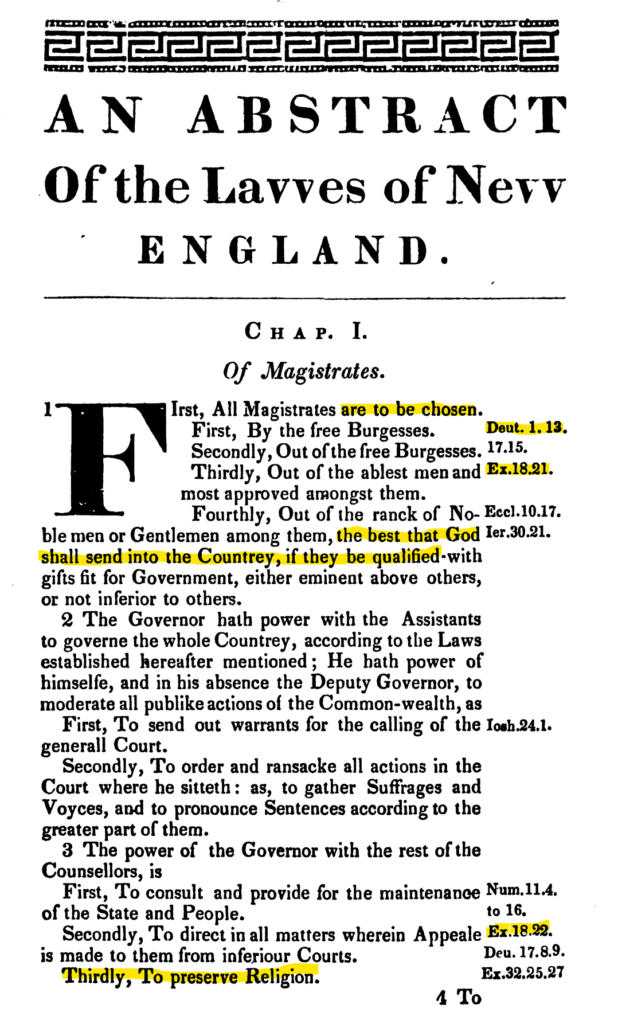
In addition to Thomas Hooker, Massachusetts Bay minister John Cotton gives us an insight into how Exodus 18:21 is core to the foundation of our country. In An Abstract of the Laws of New England (1641), he cites Exodus 18:21 to show that the “ablest men and most approved” are to be chosen by the free burgesses. But not just the best candidates, but the best “…if they be qualified”. It’s also interesting that one duty Cotton gives to the magistrates is to “preserve religion”. One must be qualified by the standards of the Christian religion to be able to preserve it.
Yet, let’s say that you disagree with my take on Exodus 18:21, and you have a myriad of reasons for it. There are far more verses that I would point to in order to make my case that voting for a pro-abortion candidate is a sin.
Argument 2:
Proverbs 28:17 tells us, “If one is burdened with the blood of another, he will be a fugitive until death; let no one help him.”. The NASB renders it, “A person who is burdened with the guilt of human blood will be a fugitive until death; no one is to support him!”
We are not to support those burdened with the guilt of human blood. Any legislator that refuses to prosecute abortions as murder is burdened with the guilt of human blood. (Leviticus 20:4-5) While on its face, this may seem like a clever twisting of words, it really isn’t. The two previous verses make clear the context:
Proverbs 28:15-16 NASB20 –
[Like] a roaring lion and a rushing bear
Is a wicked ruler over a poor people.
A leader who is a great oppressor lacks understanding,
[But] a person who hates unjust gain will prolong [his] days.”
Is it not true that a man who sanctions the death of unborn children, by his political actions, his rhetoric, and his advocacy is burdened with the guilt of human blood? We are called not to support such a man, or to assist him, uphold him, or give him help.
Yet, isn’t that exactly what a vote is? It’s a political device to help him, support him, or promote him to an office. It’s clear to me that Proverbs has rulers in mind when it speaks of this man, laden with bloodguilt. Even if there is a change of subject matter between verses 16 and 17, the principle is still clear. A man who is laden with bloodguilt is not to be supported.
But isn’t that exactly what we see in election years? If there is a man who is guilty of promoting or perpetuating abortion, as long as he is the “lesser of two evils”, men flock to his aide to support him from the rhetorical onslaught of Christians.
Many times, they will reluctantly acknowledge that the man needs to repent of his position, but they’ll spend the majority of their energy on the subject fighting back against those who would call on Christians to not support such a man. Other folks may see this, and they won’t spend much of their energy fighting back against those Christians, but they’ll still say to the pro-abort candidate, “I wish you would change on this, but you still have my support”.
Is this what the Word of God requires? Does the Word say, “If a man is laden with bloodguilt, feel free to support him, but at some point make it clear that you’re not a fan of his bloodguilt”? Of course not. The Word is clear on this. Shall we listen?
Argument 3
Can we be allied with wicked rulers, who condemn the innocent?
Psalm 94:20 ESV –
Can wicked rulers be allied with you,
those who frame injustice by statute?
They band together against the life of the righteous
and condemn the innocent to death.
As Matthew Henry puts it, “They humbly expostulate with God: “Lord, shall the throne of iniquity have fellowship with thee? Wilt thou countenance and support these tyrants in their wickedness? We know thou wilt not.” […] Far be it from the just and holy God that he should be the patron of unrighteousness, even in princes and those that sit in thrones, yea, though they be the thrones of the house of David.”
We are to hear the hypothetical put forward by the psalmist here and say, “Of course God isn’t allied with the wicked rulers!” The question is, can we be? Are we to be allied with folks God has said He isn’t allied with?
Folks are bound to say, “I’m not allied with him, I’m merely voting for the good things he promises to do.” Yet, using your political power to install a leader is an alliance, no matter how you put it. There’s a reason we call it “supporting” a candidate when you intend to vote for them. The etymology itself of the word “vote” betrays this. It comes from the root “vovere”, to vow. You are vowing your support to him, come what may.
The rhetoric of these folks who say “they aren’t allying with him” often betrays them. Many, though not all, when they have decided in their hearts to support the man, will spend their energies fighting those who are against his wicked schemes, instead of fighting those wicked schemes themselves. Consider this: A “lesser of two evils” will always become a “preferable evil”, and if left unconfronted, will become a “preferable good”.
This was made obvious during Trump’s 2024 campaign. There are many who, when Trump signaled so many times his support for abortion, argued that he was lying in order to get votes. Eventually, in order to dissolve the tension in their own minds, they had to begin seeing lying in that manner as a prudent good. Now that it is clear that he wasn’t lying, they will not correct the record, of course, because these are people who are fully yoked with him in their hearts.
2 Corinthians 6:14 ESV –
Do not be unequally yoked with unbelievers. For what partnership has righteousness with lawlessness? Or what fellowship has light with darkness?
What accord has Christ with Belial? Or what portion does a believer share with an unbeliever?
Even still, there are those who did critique Trump on the issue of abortion, albeit timidly, yet their alliance with him, and their yoking to him was made obvious in other ways. Anyone reading this should take stock of their own actions, and ask themselves what motives led to them doing such things.
Ephesians 5:11 tell us, “take no part in the unfruitful deeds of darkness, but rather expose them”. It doesn’t say that we can pragmatically take some part in deeds of darkness. It doesn’t say that we should elevate a lesser deed of darkness and tell people to fight that by taking part in a greater deed of darkness. It doesn’t say that we can fight more apparent deeds of darkness by electorally taking part in less “in-your-face” deeds of darkness.
If I was Satan, I would create candidates that were cartoonishly anti-Christian, and then create another candidate that was anti-Christian, but signaled loving support to Christians at the same time. The Christians would vote for the one signaling support, because they’re easily tricked, and they see fighting the cartoonishly anti-Christian side as the highest good. Then, as the culture slowly shifts away from Christ as a result of this scheme, I’d cause the anti-Christian side (the left) to be so cartoonishly evil, that any Christian would seem insane not to compromise in order to defeat them.
After all, it’s “good vs evil” at this point, right? “You can tell, because of how evil the left is.” So the Christians (because of a lack of discernment) now yolk themselves to the right, and plant their flag: “The Right Must Win”.
What they don’t realize is that the left has gotten so cartoonishly evil because of the way they themselves have compromised over several generations. The Right is now The Left of a decade ago, because this slide has been allowed to happen, by the people who are actually in charge of human history: The people of God. I believe that God directs human history according to His will, but at the same time, he allows His people to lead the charge.
The left is not in charge, we are. I believe the entirety of human history after Christ’s resurrection is the grand story of Christ’s Bride being perfected. Christ is the main character in this story, and the Church is His body. Yet, Christians are duped into thinking they have no control, especially in electoral politics. They are often weak, cowardly, and impotent.
In order to explain logistically how taking a stand with a “neither” vote can and will actually shift the culture, I want to commend this short video series that explains this dynamic well. It also explains what has really been happening this whole time, for several decades. His explanation is imperfect, but he gets the point across. Five Steps to a Political Epiphany
What you’ll find is that because folks who have supported a candidate feel a sort of unity with them, they will now feel invested enough to defend that administration against enemies of that administration who are within Christ.
We’re seeing that today, a year after Trump’s inauguration. They’ll point to The White House sharing bible verses, and claim “The Christian Nationalists have won!”, or they decry “blackpilling”. Yet they know, because they’ve read the same Bible that I have, that the Israelites were explicitly castigated by God for doing that exact thing, while simultaneously hating God or God’s image with their actions. This pattern is throughout the prophets.
That’s why I believe, when things get this bad, God exposes how bad they are by having this God-hating administration share Bible verses, while also supporting the mass slaughter of babies. They’re even ramping it up to the nth degree through IVF. This is God showing us that we are under judgement. We are in the exact position Israel was in when God sent his prophets to warn them of their double-tongued hypocrisy.
Isaiah 29:13-14 ESV –
And the Lord said:
“Because this people draw near with their mouth
and honor me with their lips,
while their hearts are far from me,
and their fear of me is a commandment taught by men,
therefore, behold, I will again
do wonderful things with this people,
with wonder upon wonder;
and the wisdom of their wise men shall perish,
and the discernment of their discerning men shall be hidden.”
Concluding this section, let’s remember the question we’re seeking to answer: “is voting for a pro-abortion candidate a sin?” One must ask themselves, “Is going against God’s standard a sin?” And if yes, what is God’s standard?
Is it His standard that we 1) follow the guidelines laid out by Exodus 18:21, 2) not support a man laden with bloodguilt, (Prov 28:17) 3) not ally with wicked rulers who frame injustice by statute, (Psalm 94:20) 4) not yolk with unbelievers, (2 Corinthians 6:14) and 5) not take part in unfruitful works of darkness? (Ephesians 5:11)
If the answer to any of these is “yes”, then voting for a pro-abortion candidate is a sin, because it falls short of God’s standards. Yet, there are even more sins that may be involved, which are sometimes made evident by the way men argue against this standard.
Answering objections
Objection: “Voting is an issue of conscience”
Answer: Let’s revisit Isaiah 29:14.
Because this people draw near with their mouth
and honor me with their lips,
while their hearts are far from me,
and their fear of me is a commandment taught by men,
While it is true and necessary to fight against those who would bind the conscience of believers to commandments not taught by men, we also need to consider that there is a danger of calling the fear of the Lord “commandments taught by men”. I have been accused of “binding consciences unjustly” on this issue many times. I pray that the above section has made it clear that my argument has never been based in self-made commandments, but in fear of the Lord, and serious consideration of his Words on the matter.
As Herman Bavinck puts it, “[The conscience] must therefore be governed and corrected by the Word of God…Only the Word of God can enlighten the conscience, making it a reliable guide. A conscience apart from Scripture easily becomes either lax or tyrannical.”
One may say that the complexity of the voting issue puts it in the realm of individual conscience alone. I don’t understand that argument, as so many things that we bind people to are far more complex than this. I think supporting a person who intends to perpetuate the legal slaughter of babies is a pretty cut-and-dry issue. Was Uzzah’s dilemma a “complex issue”? Of course not. Yet, I would say it’s more complex than the issue of appointing a child-sacrificer.* Yet God didn’t treat it like a conscience issue, but as a violation of God’s Law, worthy of death.
I have heard that voting must be an individual conscience issue, because of the secret and personal nature of voting. Yet, is this not also true of many things? Your internet browsing history is a private matter, too. Should we consider that an “issue of conscience”?
In fact, this logic is very similar to the logic used in Griswold v Connecticut, the Supreme Court ruling that made contraceptives a “Constitutional right”, by citing the invented “right to privacy” they “found” in the “penumbras” of the Constitution. This belief that a thing being done in private makes it outside the jurisdiction of the state, is what led to the justifications used in the Roe v Wade decision. If something being private puts it outside of the realm of jurisdiction, then abortifacient birth control, and even self-managed abortion, can’t be criminalized.
Now, if what you mean by “issue of conscience” is that you believe it’s not an issue worth dividing over, or not one worthy of church discipline, then I understand. Like many things, we can disagree and still remain united. Yet, I think telling someone that their Scripture-based belief that voting for a pro-abortion candidate is a sin is not to be spoken of as if it’s sin, is an error.
*A note on the term, “Child Sacrificer”: You may retort that a lawmaker who perpetuates child sacrifice is not directly sacrificing children himself. While that may be true that he isn’t personally handling the tools or medicines, and putting it down women’s throats, he is using the lives of unborn babies to get elected. He’s devaluing the issue for political expediency, and he’s allowing the evil to continue so that he can remain in power in peace. This is sacrificing children for political gain.
Objection: “We have to weigh our higher loves over our lower loves, and we should vote for the good of our children over the good of our enemies’ children”
Answer: The moment the doctrine of “Ordo Amoris“—the Order of Loves—is used to justify neglecting God’s Law or moral standards in pursuit of a “higher love,” its spirit is utterly inverted. So much so, in fact, that it ceases to be an “order of loves” and becomes, instead, an “Order of Neglects,” or Ordo Neglectus, you could say.
This twisted logic allows one to slight God’s commands in favor of, say, one’s own children. The question then becomes: “Whom shall I neglect first?” An easy initial answer is often “the unborn children of my enemies.” We are told to ignore our divine duty to them, justifying that omission with “love” for our own born offspring.
But since all true love is rooted in the love of God—and loving God means keeping His commandments—the highest love is what this flawed formulation of Ordo Amoris betrays. The “love” shown to one’s own children, therefore, is not ordered love at all. It is merely the neglect of others God commands us not to sin against, dressed up in the complex language of Augustine.
And yet, I heard the voices—bouncing off the upward-tilted chins of my critics—claiming that this “I love my own born children more than the unborn children of my enemies” sentiment was “grade-A, orthodox Ordo Amoris logicking.” But no, sir. No sin can ever be excused in the name of love. No theft, no betrayal, no murder is justified by the plea, “It was for my children.” I cannot vote to steal my neighbor’s wages to forgive my family’s student debt in the name of loving my kids more than my neighbor’s pocketbook. I cannot even steal bread from a Jewish store owner by claiming to “love my own children more than the coffers of the Synagogue of Satan.”
Love can never lead to sin. Doing evil that “good” may come can never make the evil “good”. Let the truth be stated clearly: “Love” that betrays the higher love of God is not love at all; it is mere pagan affinity.
Luke 14:26 ESV –
“If anyone comes to me and does not hate his own father and mother and wife and children and brothers and sisters, yes, and even his own life, he cannot be my disciple.
The love of our children can never cause us to sin against God or His image bearers. The love of God and His Law should be of such a higher degree of importance that in comparison, we are hating our kin. This is the purpose of Christ’s hyperbolic statement in Luke 14:26.
Matthew 5:46-47 ESV –
For if you love those who love you, what reward do you have? Do not even the tax collectors do the same? And if you greet only your brothers, what more are you doing than others? Do not even the Gentiles do the same?
Christ knew that men would use “love of their own” to excuse all sorts of heinous things. This is why He said these things like he did.
Matthew 10:34-39 ESV –
“Do not think that I have come to bring peace to the earth. I have not come to bring peace, but a sword. For I have come to set a man against his father, and a daughter against her mother, and a daughter-in-law against her mother-in-law. And a person’s enemies will be those of his own household. Whoever loves father or mother more than me is not worthy of me, and whoever loves son or daughter more than me is not worthy of me. And whoever does not take his cross and follow me is not worthy of me. Whoever finds his life will lose it, and whoever loses his life for my sake will find it.
Objection: “Electorally supporting abortion is an evil, but I’m not voting for that. I’m voting for the other stuff”
Answer: When voting for an omnibus package in Congress, many Congressmen probably convince themselves that it’s okay to vote for that package that has terrible, sinful things inside of it, because of the “good” that may come. Maybe they were incentivized by securing funding for projects that are of great interest to their constituents. Maybe they were assured certain levels of influence with the administration if they got in line. Maybe they were even blackmailed into voting for the bill, and they convinced themselves that retaining their position and salary was the best thing for their family, and their community, and even the world at large, because of their “altruistic influence”.
The thing is, in all of these instances, the Congressman has convinced himself that the evil done by voting for this terrible bill to pass is made permissible by the good that may come of it. By now, you may be realizing the problem, as stated earlier in this article: No amount of “good that may come” can permit an evil.
Romans 3:8 ESV –
And why not do evil that good may come?–as some people slanderously charge us with saying. Their condemnation is just.
If you vote for a politician who promises to continue the slaughter of the unborn, as Trump had, this is an evil, as I’ve laid out previously. The charge that “good may come” of it is not an excuse, and is directly and indirectly condemned in Scripture.
Objection: “You’re just purity spiraling”
Answer: Thank you!
Objection: “Not voting for Trump is allowing the worst candidate to win, which is sinful. You’re essentially hoisting judgement upon us, my children, and my community”
Answer: It’s interesting that the folks who say this to me largely consider themselves cessationists. It’s funny that they attempt to prophecy the future anyways.
Indeed, it is not our job to assume what God will do with our faithfulness. Yet, Christians who have read the Bible know that this happened on numerous occasions in the narrative. One example I like to point to is the ten bad spies who spied on Canaan, and dissented to the faithful braveness of the two good ones.
“What God has commanded us to do here is too dangerous. There are giants in the land. If we were to attack, we would fail. The odds are too great against us.”, they said.
This is the sin of presumption. You presume what will happen based on your human reason, and what God has commanded falls to second place in your heart, behind the fear you have of the future. Yet, this presumption also has an even worse side of it: false prophecy. Read Ezekiel 13, and you’ll see false prophets exclaim to the culture what good tidings will come from disobedience. They, “prophecy smooth things from their own hearts.”
Is this not what happens in a general election, when faithful Christians fight against the statist tide of emperor worship? “You want to destroy us”, folks will sneer back. “No, if we vote for this man, we will have our home again. There will be a Golden Age of America First renewal.” This is religious language. It’s not mere predictions, it’s prophecies. They’re false prophecies, with motives at least as old as Isaiah 31:1-3.
Isaiah 31:1-3 ESV –
Woe to those who go down to Egypt for help
and rely on horses,
who trust in chariots because they are many
and in horsemen because they are very strong,
but do not look to the Holy One of Israel
or consult the LORD!
And yet he is wise and brings disaster;
he does not call back his words,
but will arise against the house of the evildoers
and against the helpers of those who work iniquity
Ezekiel 13 and Isaiah 31 both should terrify someone who feels an emotional outpouring of religious love towards leaders that they’re putting their hope in, while ignoring their promised evils, for the purpose of quelling their fears, or for some hope of gain. They are the people these passages warn about. They are not to be listened to.
Objection: “Wait, but you compromise, too. You buy from Amazon.”
Answer: This is a category error. By doing business with pagans, you are not instituting their laws, or instituting a pagan lawmaker. The Old Testament allows Christians to do business with pagans.
Deuteronomy 2:6 ESV –
You shall purchase food from [the Edomites] with money, that you may eat, and you shall also buy water from them with money, that you may drink.
John Calvin agrees: “If the Lord has willed that we be helped in physics, dialectic, mathematics, and other disciplines, by the work and ministry of the ungodly, let us use this assistance.”
Could they possibly use money that you paid them for evil deeds? Yes. This is true even if you don’t do business with them, though. Frederick Bastiat said, “By virtue of exchange, one man’s prosperity is beneficial to all others.” Any purchase at all creates a butterfly effect that affects the economy in infinite ways. God has not ordered the world in such a way where you can be free of your economic trade being used for evil, even if we should be wise to try and prevent it when possible.
Yet, I see it as a clear fact that God doesn’t allow us to directly institute evil laws or appoint evil lawmakers.
Objection: “But Trump got Roe Vs Wade overturned! This is proof that compromising works!”
The fact that Christians think that overturning Roe Vs Wade was a “monumental victory” in the fight against abortion is a fruit of the compromise I’ve been decrying in this article. Not only was Dobbs—the Supreme Court decision that overturned Roe—iniquitous, I would like to make the case that it was deleterious to the effort of abolition as well.
Before Roe was overturned, abolitionists were fighting for the nullification of Roe, while the pro-life establishment was fighting for “regulation with compliance to Roe“. This was insane, as state nullification is a fundamental right of the American system of government, but it was also evil. When Dobbs overturned Roe and “gave that choice” to the states, many people considered the fight over. All it really did was remove the “we have to submit to Roe” talking point from the mouth of the Pro-Life establishment.
Now that Dobbs is in place, and in many states abortion clinics have been closed, Christians all over the country are lulled into a feeling of accomplishment, as if we’ve won a massive victory over abortion. The fact of the matter is that abortion numbers have not gone down in any meaningful way, and have even gone up nationally. I would argue that it’s even gone up in ways that we can’t record, as the predominant way to abort your baby now in states like Oklahoma are anonymous, cheaper, and more convenient than ever.
I don’t want to get too deep into this discussion here, because I produced a docu-series called “Abortion-Free” about this very subject.
The point is, Trump is taking credit for something that has not only been ultimately meaningless, I would say it’s been harmful. Furthermore, his public statements have really left me with the impression that he regrets even doing that. Seemingly, when a “pro-life” state has a constitutional amendment protecting abortion “rights”, he’s giddy about it.
Yet, some people will act like Dobbs was some miracle decision, and that Trump is the greatest hero in American history for appointing the Supreme Court justices that made it happen. Some of these people even know and have been told the problem with this stance, and they parrot it anyways. This is an evidence to the content of their character.
Conclusion
I say none of these things in hate. I say them because I believe what the Bible says is true, and because I really do love my family, and my church, and my nation. I believe the way that we act on the stage of Earth signals to God how he should treat us. Refusing to sin in our electoral system is “an appeal to heaven.” Adversely, allowing ourselves to sin in our electoral system is a “signal to heaven of a lack of faith”.
When you vote for a pro-abortion candidate, you signal to God that your higher priority is cheaper food prices for your family, or the ethnic makeup of your neighborhood, or cheaper gas prices… over ensuring that you are not taking part in the bloodshed of the littlest among us.
What does God do when Christians sully themselves with the blood of the innocent? He brings judgement. Foreigners flood the land. Our leaders become sexually confused. Women and infants take charge where men fail to lead.
This is especially true when the ones compromising are Conservative, theologically-minded, even reformed Christians. What if God is looking just at this group of Christians, deciding what to do? What if He is only looking at one man, and that man is you? What if your decision to be faithful is the one thing that stays the hand of God from bringing His wrath?
I believe what we see every election season is a reflection of what God saw in ancient Israel, when they looked for a king where one was not prescribed for them. (1 Samuel 8) I don’t see this as a blanket condemnation of governmental authority, but I do see it as a condemnation of the tendency of people to compromise their values in their fervor to institute an authority figure. What God warned Israel would take place in the case of Saul often reflects what happens to us, when we elect Godless leaders with the same religious fervor.
We should not act with the wisdom of man. We should look to what God says on the matter, and do what He says, no matter how unlikely it seems that these actions will result in “success”. There’s nothing pragmatic about marching around a wall thirteen times while blasting trumpets if you want that wall to be torn down. It doesn’t make sense with worldly wisdom. Rather, the most wise and most pragmatic thing to do at every given moment is what God says to do, and never what God says not to do.
When we see the giants in the land—immigration, sexual degeneracy, Israel…—our response should be to turn to God, and allow him to guide our steps, come what may. We shouldn’t compromise with child sacrifice in the fight to end child sacrifice.
“The central problem of our age is not liberalism or modernism, nor the old Roman Catholicism or the new Roman Catholicism, nor the threat of communism, nor even the threat of rationalism and the monolithic consensus which surrounds us. All these are dangerous but not the primary threat. The real problem is this: the church of the Lord Jesus Christ, individually corporately, tending to do the Lord’s work in the power of the flesh rather than of the Spirit. The central problem is always in the midst of the people of God, not in the circumstances surrounding them.” – Francis Schaeffer
Addendum: Supporting or Uniting With Sycophants
These sycophants reflect the character of Doeg the Edomite, in 1 Samuel 22. When the priests—specifically Ahimelech—harbored David, and did what was disagreeable in the sight of Saul, they were unjustly condemned to death by Saul. Doeg betrayed Ahimelech and told Saul about how Ahimelech gave David a sword and provisions. Ahimelech seemingly did this in innocence, as he wasn’t even aware Saul was against David. Saul told his guards to kill Ahimelech and all the priests, and they refused. Saul turned to Doeg, and Doeg willingly killed eighty-five priests that day. He was a treacherous individual who used his knowledge of David’s prior meeting with Ahimelech to curry favor with Saul, and in a watershed moment, allied with the God-forsaken king, against the people of God.
I believe Scripture is clear that sycophants are not to be trusted. Sycophants woo you with their flattery, and they also gain power, influence, and wealth by their sucking up to power.
These are the “loud-mouth boasters, who show favoritism to get an advantage.” spoken of in Jude 1:16.
A man who, when seeing Christians attack their candidate for Godly reasons, goes after the Christians attacking them to divert their righteous sting, instead of joining them in their push for righteousness, is a dangerous man. They are divisive by nature, by fighting the prophetic duty of the church.
Romans 16:17-18 ESV –
I appeal to you, brothers, to watch out for those who cause divisions and create obstacles contrary to the doctrine that you have been taught; avoid them. For such persons do not serve our Lord Christ, but their own appetites, and by smooth talk and flattery they deceive the hearts of the naive.
There are many naive people. A general election is a breeding ground for naive sentiments to turn into idolatry. Sycophants will use that naivety and through smooth talk and false prophecy use that naivety to their advantage. These men are not to be trusted. They are not good men. They are liars, and their lies serve to bring dishonest gain.
This warning should be double for those whose careers are furthered by the success of the ruler they’ve yoked themselves to. As a man reaches stature in the political field, there will always be a temptation to play that game, in order to reach higher rungs of that ladder, and ignore those problems that their conscience brings to their mind along the way. This is no call to remain apart from politics, but it is a call to beware of the wolves who prey around those halls. Deception is everywhere. “Do not be deceived: ‘Bad company ruins good morals.’” (1 Cor 15:33)
I want to posit that as abolitionists, we should not platform or yolk ourselves to these men. Now, I’m not saying that we can’t work with folks who have voted for Trump. People will accuse me of that, but that’s not what I’m saying. I am saying that platform-seekers and political ladder-climbing types are not to be heralded as examples of our movement. Scripture warns against these people.
There are also those who are not platform-seekers or anything like that, but by their voting for Trump, and their articulated reasons for doing so, they make it obvious that they don’t understand much of abolitionism itself. Abolitionism is providential, not pragmatic. Pragmatism is fine, but worldly-wise pragmatism is the enemy to aligning providentially. I don’t believe people who betray this principle should be heralded, either.